Stars and Stellar Magic
What Are Stars?
A star is a large, luminous sphere of plasma, held together by gravity and radiation pressure, which at the end of its life may contain a proportion of degenerate matter. (Wikipedia)
Stars are the great Forges of the Universe: most of the elements that make up everything that exists, including us, came from inside them. For those of us here on Earth, they’re also a source of Light and Heat, and without that, life as we know it simply wouldn’t exist.
Stars in culture
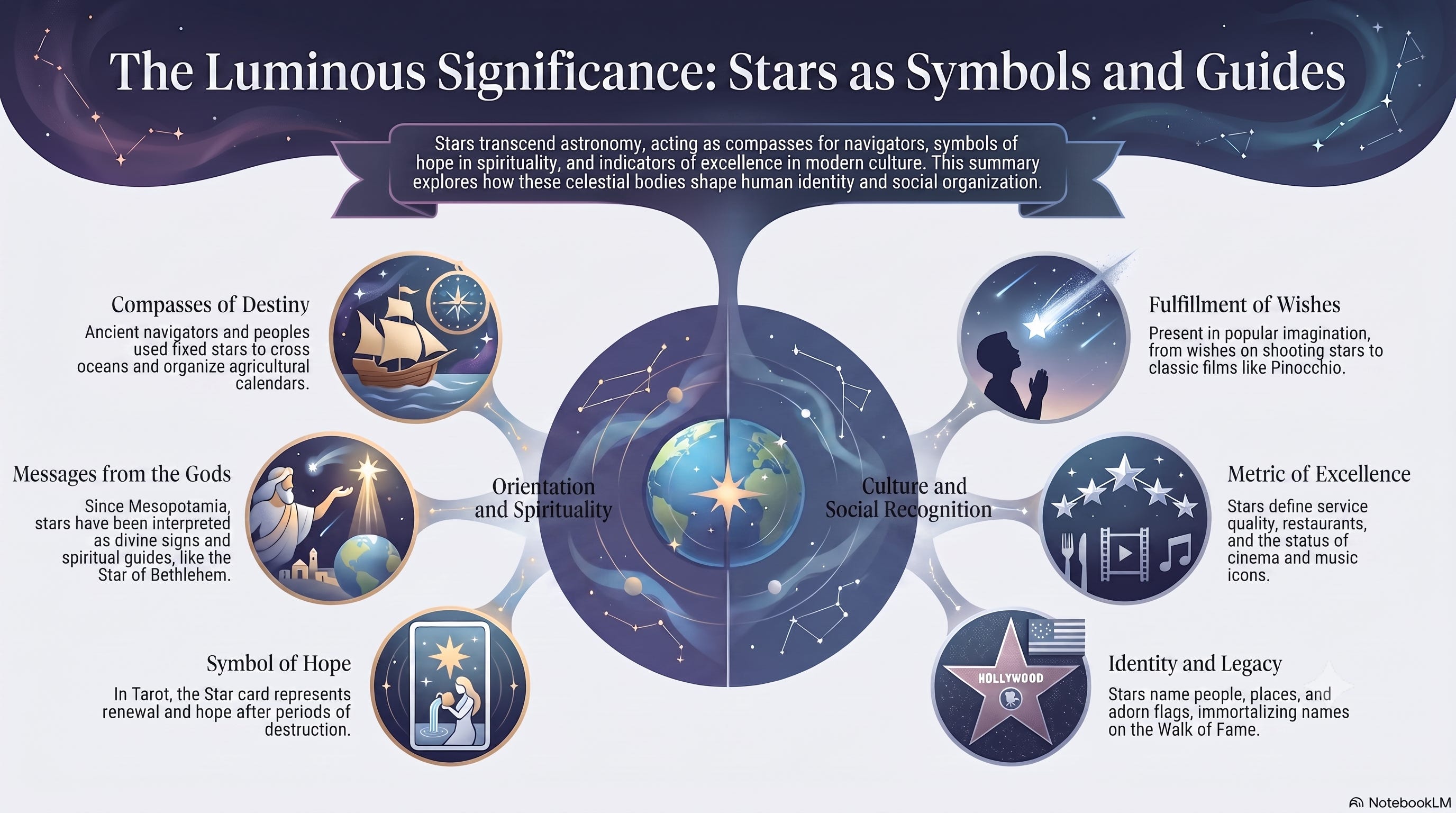
Stars show up in many contexts across our society:
- Stars are guides. The Star of Bethlehem guided the Magi; navigators crossed oceans steering by fixed stars long before any compass existed; the Ancients saw in the stars the messages of the Gods as far back as Mesopotamia, the cradle of our civilization. They were also a reference point for the agricultural calendars of many peoples.
- Stars grant wishes: from movies and shows — like Geppetto asking the Blue Star to turn Pinocchio into a real boy — to countless popular beliefs, like making a wish on a shooting star, or on the first star you see in the sky.
- Stars are hope: in Tarot, the Star card’s keyword is exactly that, Hope, coming right after the destruction of the Tower.
- Stars lend their name to people, story characters, streets, neighborhoods, cities, businesses, flags, all over the world.
- We rate the quality of services (and restaurants) using stars.
- Beyond all that, we call someone who shines a “star.” Movie star, rock star, the evening star, the birth of a star. Hollywood literally puts stars on the ground, with people’s names on them, to mark who stood out.
Anyone want to partner up to illustrate the newsletter (and the Grimoire)?
Stars in Spirituality
Here we step out of the astrophysics box and expand into the spiritual meaning stars hold. The perception of Stars from the magical and spiritual point of view on the Adhara Starpath has a bit of historical context (which I’ll tell in another newsletter, dedicated to the topic), a bit of Renaissance Hermetic philosophy, and a good amount of shared experience and extrapolation of concepts:
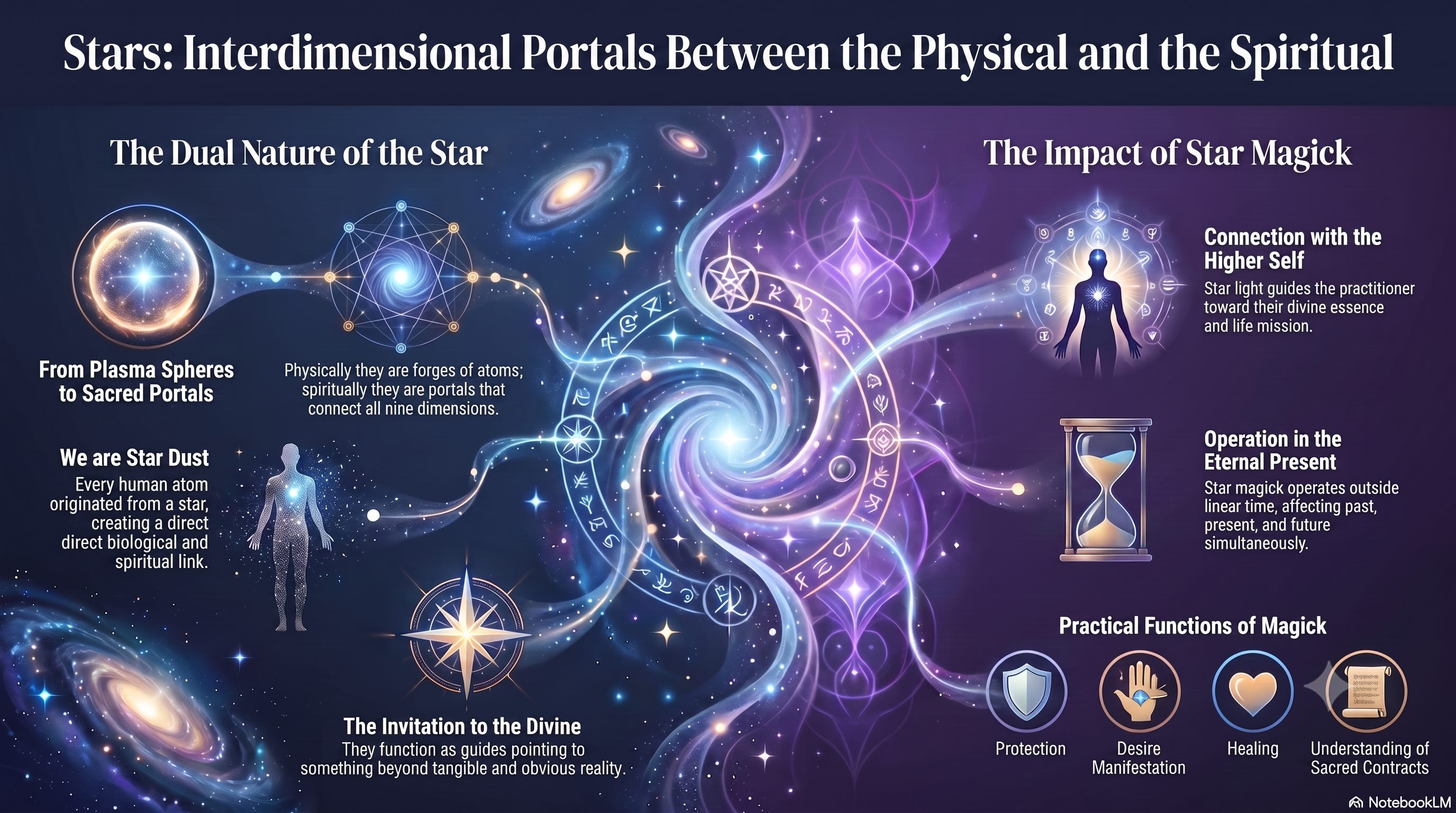
- Stars are the connection point between the physical and the spiritual: they connect time, space, dimensions. That’s why the distance between us makes no difference at all. They are the source of all Creation, and because of that they’re connected to everything that exists. They are interdimensional portals scattered throughout the whole Universe.
- Stars are guardians of memory. They’re a “great hard drive” of everything that happens on our planet. Humanity has recorded all its stories and myths, from many peoples and cultures, in the Stars and in the constellations.
- Stars are points of light in the middle of deep darkness. Working with stars means being in contact with our essence, our Divine Self, and also with our Shadow, since it’s these two aspects together that make us whole. It’s accessing our primordial nature and aligning with it.
When we do Stellar Magic, we’re accessing the egregore that has been built on top of the Stars over more than three thousand years of human history.
What Is Stellar Magic?
Stellar magic is Ascension Magic. That word might sound a little strange to us Pagans, since ascension usually brings to mind spiritual evolution, and many of us don’t believe in that. Our sense of “spiritual evolution” isn’t quite the same as what Spiritists believe, where you have to go through trials until reincarnation is no longer necessary.
For us Pagans, the spiritual experience is more fluid: we come here to learn, to live new experiences, since the Gods live our experiences through us. Many Pagans believe we choose the experiences we want to go through (the so-called sacred contracts). But not with a commitment to transcend.
Christopher Penczak, in the book Ascension Magick, mentions that the meaning of ascension can be “home,” being a new dimension of perception, leaving the world of matter, or finding your inner home [1]. In this work, we’ll use a concept similar to the third one: your inner home being your Higher Self, your Divine essence. Getting in touch with our essence is accessing our Higher Self, our magical potential that holds everything we’ve already lived and everything we’re still going to live.
Interestingly, stars don’t only speak of the Higher Self. After all, it’s only in the deepest darkness that we can see the brightest stars. In our lives, we often find a light in the middle of a storm, in a moment of deep hardship or loneliness. And that’s also a great lesson from the stars — we need to deeply know our light and our darkness to better understand where to go. Your essence isn’t made only of light, but also of your Shadow. It’s you, whole, with all your potential. And that’s also part of working with Stellar Magic: knowing all of your Light and your Shadow and working with them in balance, growing through the whole process.
For all this meaning, working magically with the Stars means working with Creation itself — everything we want to create to last, everything we are, our Divine essence and, also, everything we set out to do in our lives: our sacred contracts, the purpose we came to fulfill in each life we live.
We can still expand the concept a little further and work with other elements of the Universe: the various celestial bodies, universal beings, dimensions and planes of existence. If the stars are tied to all of creation, all of this is also part of working magically with them!
From the book A Magia das Estrelas — vol 1: Princípios de Magia Estelar (The Magic of Stars — vol. 1: Principles of Stellar Magic) — Aileen Daw, Agathos Athenodoros and Sky Zahara [2]
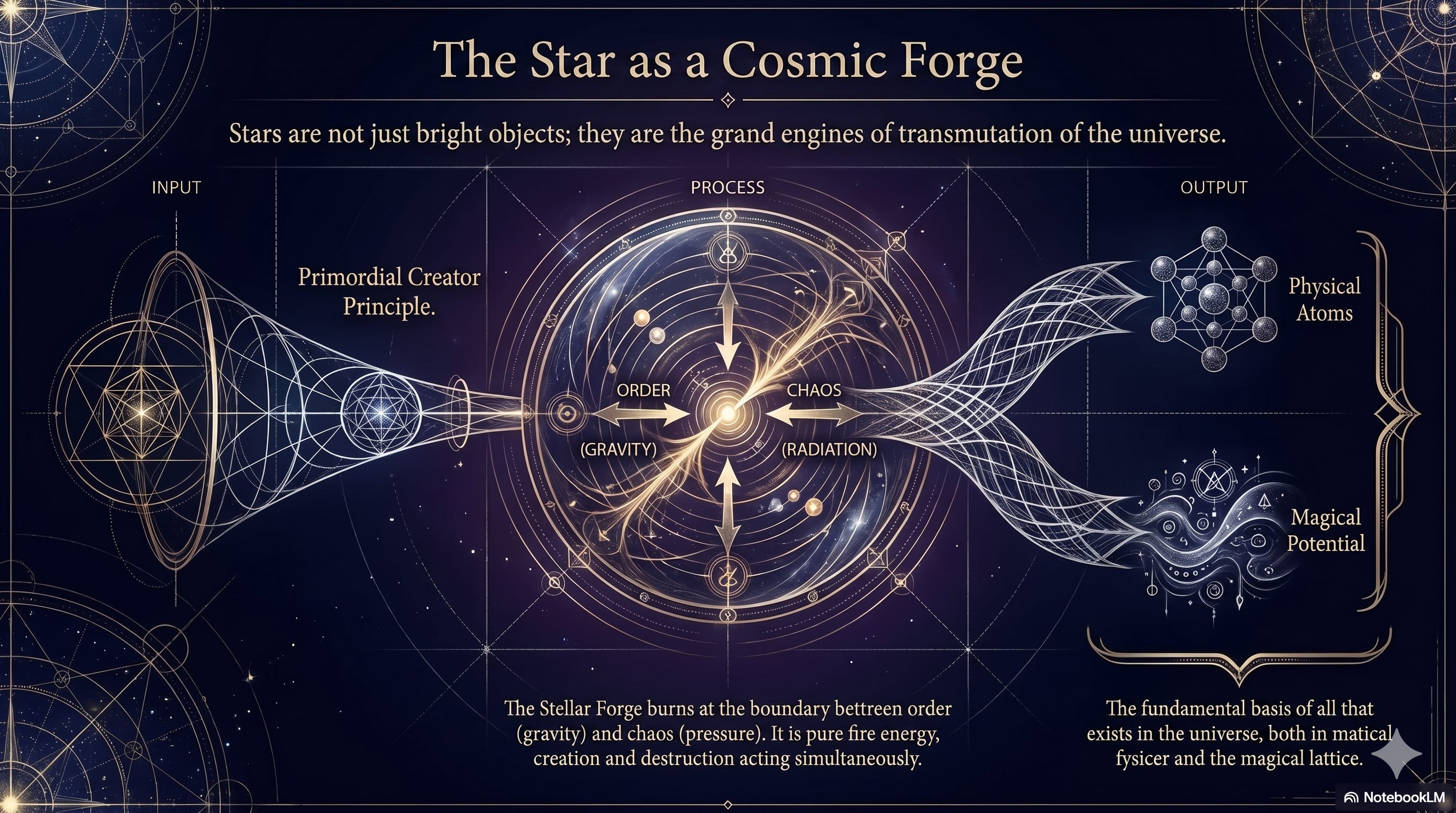
Stars are the forges of the Universe, and that's the basis of Stellar Magic!
“Science is not only compatible with spirituality; it is a profound source of spirituality.”
Carl Sagan, The Demon-Haunted World: Science as a Candle in the Dark
Principles of Stellar Magic on the Adhara Starpath
The Adhara Starpath system is very simple and rests on four principles. All of them start from the same idea: the position of the Stars in the sky, as the Ancients saw it.
The Ecliptic and the Chaldean Order
The Sun, the Moon and the planets we can see with the naked eye — Mercury, Venus, Mars, Jupiter and Saturn — all seem to travel along the same band of the sky, a path called the ecliptic. In practice, it’s the reflection of the plane in which the Earth and the other planets orbit the Sun, seen from down here. That’s why the Moon, the Sun and the planets never appear scattered anywhere in the sky: they always follow that same route, crossing, year after year, the same constellations we know as the signs of the zodiac.
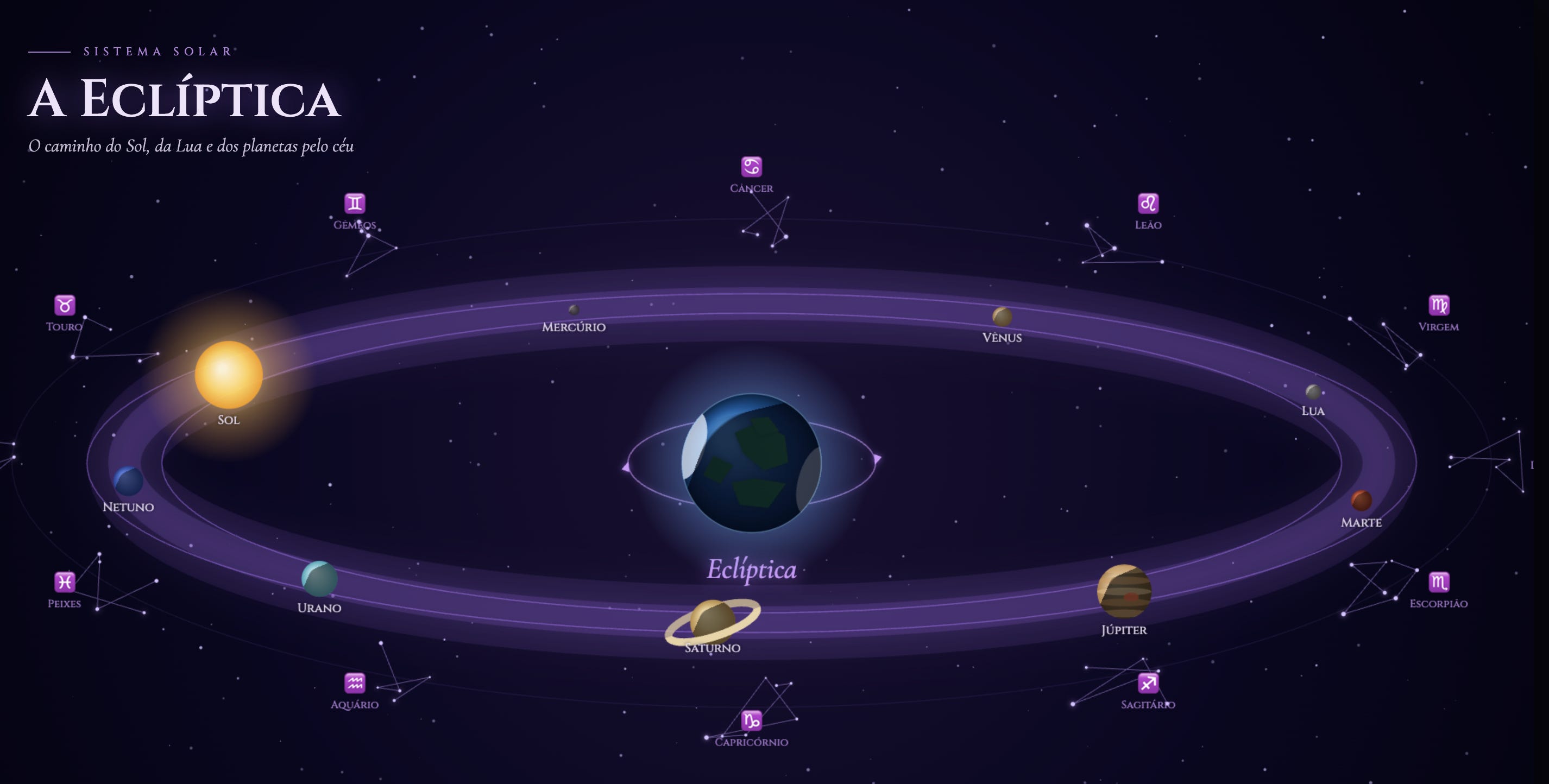
The Ecliptic — Made in Claude Design — see the animation here
From this point of view, the planets don’t orbit in perfect circles nor at the same speed, and that’s what creates the sense of retrograde motion in planets. It’s an effect of perspective: since Earth is also moving, at certain moments it overtakes a slower planet, or gets overtaken by a faster one, and during that overtaking, seen from here on Earth, the other planet appears to slow down, stop, and move backward a little before resuming its normal course. It’s the same illusion as when you’re in a car driving alongside another one: if your car speeds up, for a moment it looks like the other car is moving backward, even though it keeps going forward, just more slowly. Retrograde motion is always relative to Earth, never an actual movement of the planet in space.
It’s this interplay of orbits, speeds and angles that traditional Astrology observes and interprets: aspects, retrogrades, lunar phases, all of it depends on where Earth is and how the other bodies of the solar system are positioned relative to it at a given moment. And that’s exactly where the fundamental difference between Astrology and Stellar Magic comes in: for the ancients, the Stars were never part of this game.
In the Dream of Scipio, the final part of his work De Re Publica, Cicero describes a very specific order for the Universe: Earth at the center, and around it concentric spheres carrying (from lowest to highest) the Moon, Mercury, Venus, the Sun, Mars, Jupiter and Saturn [3]. This scheme of seven planetary spheres later became known as the Chaldean order, and Macrobius, commenting on that very same Dream of Scipio, is the one who makes this structure clearest: after Saturn’s sphere comes an eighth sphere, the Heavens proper, where the fixed Stars “dwell” [4].
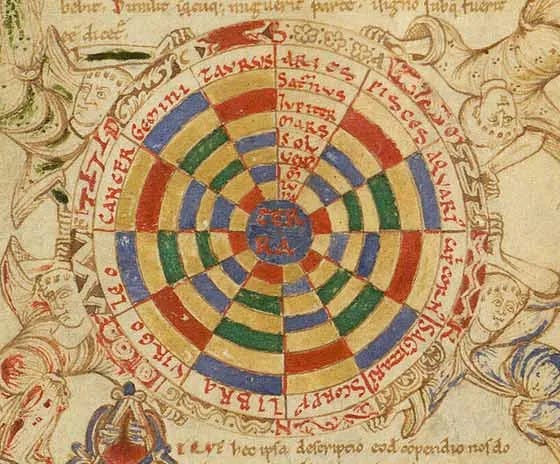
The Chaldean order — Image from De Re Publica
And here’s the essential point: for the ancients, the seven planetary spheres were made of the same four classical elements that make up our own world here on Earth: Earth, Water, Air and Fire. But the sphere of the fixed Stars was not. Aristotle called this substance Aether, a fifth essence that doesn’t age, doesn’t decay, doesn’t change [5]. While the four elements live in constant transformation, Aether is eternal and incorruptible by nature.
It’s this idea that the Stars reside in a sphere beyond all of the planetary machinery that underlies the four principles of Stellar Magic. The stars don’t spin, don’t go retrograde, don’t change phase. They simply are, eternal and whole, out of reach of the clock that governs the Sun, the Moon and the planets.
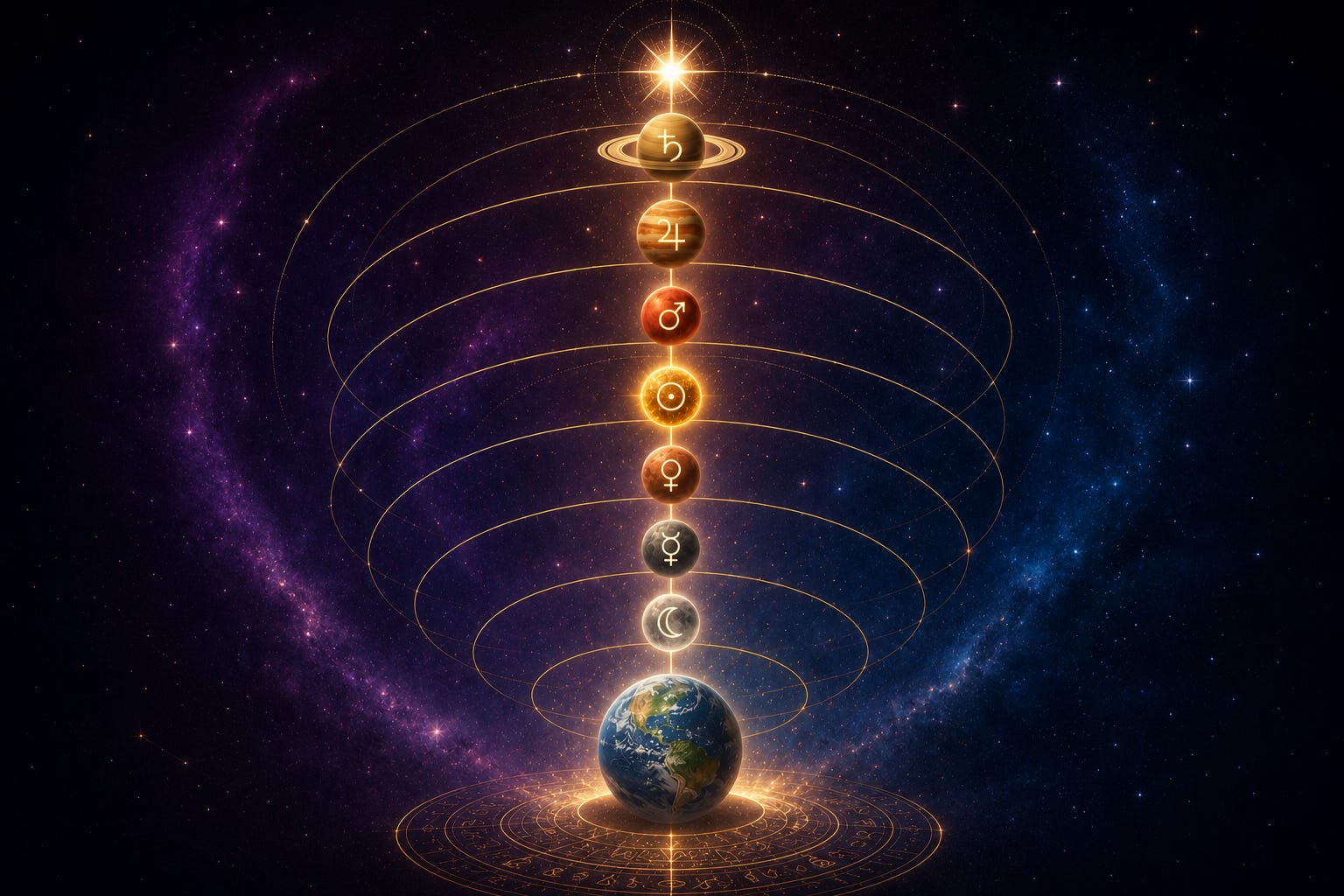
The Chaldean order — Stars beyond the planetary spheres
That being said, the principles that govern Stellar Magic on the Adhara Starpath are:
1. Stellar Magic is timeless
Stars are in the sky at all times; by day, by night, behind clouds, beneath the light pollution of a big city. The same light that reaches our eyes today also reached the eyes of those who lived long before us, and will reach the eyes of those who come long after.
Being thousands of light-years away from us, the starlight we see in the sky is always from the past. That’s why, magically, the Stars act beyond time. Working magically with the Stars doesn’t depend on time of day, day, or place. Their energy is always available and always works.
When you do Magic with Stars, that effect doesn’t happen only now. It happens in a dimension outside of time, changing you across the whole of your existence — past, present and future, all affected at once, in a single movement. The Eternal Present.
That’s why you don’t need to wait for the right Moon, or the right day, to do a working with Stars. They don’t follow that calendar, because they reside in a sphere that is beyond it.
Because they’re portals of access to any time and space, it’s also possible to do temporal magic with Stars: bringing healing to a situation that already happened, or casting a blessing on an event that hasn’t happened yet. The effect doesn’t follow the straight line of time any more than starlight respects distance.
2. Stellar Magic doesn’t depend on Astrology
As we’ve seen, the Stars reside in the sphere of the Aether, in the primordial source of all powers, beyond any planetary grid. Energy flows from the Stars to the planets, and the planets act as mirrors, redistributing down here, in our material reality, what already comes from up there, from the Aether. The planets receive the stellar emanation and reflect it back to Earth, each with its own shine, its own alloy. The Star’s force remains whole and available, whether or not a planet happens to be mirroring it at a given moment.
While the planets orbit within a machinery that’s constantly changing, entering and leaving aspect, going retrograde, moving closer to and farther from one another, the Stars are always following the same path, in the same places.
While Astrology studies how these bodies translate down here on Earth, in Stellar Magic we use that information to work in our favor, and also to soften the aspects we interpret as malefic, including in a birth chart.
A good example of this is the star Algol. Astrologically, it’s considered one of the most malefic Stars there are: wherever it falls in a chart, it’s generally associated with some kind of serious harm. Astrologer Bernadette Brady even says that if a person can contain the unconscious impulse for revenge and direct that passion toward a more productive outcome, Algol becomes one of the most powerful Stars in the sky [6]. That’s exactly what Stellar Magic does: Algol can be an excellent protector, sending a magical attack back to whoever sent it.
Another example is Facies, the nebula in the Archer’s face, in Sagittarius. For Brady, Facies is one of the most violent objects in the sky, tied to cruelty when out of balance. But she also notes that, historically, Facies was used as an eyesight test for archers: only those with truly sharp aim could make out that faint little point in the sky [6].
So the same energy that Astrology labels “bad” is, in Stellar Magic, an intense energy that can be directed toward justice, defense, retribution. There are no benefic or malefic bodies in Stellar Magic. There are different ways of working with that energy, depending on the goal.
Even so, Astrology is an important ally of Stellar Magic: knowing a Star’s astrological rulership helps a lot in understanding its nature, in choosing the right Star for a specific intent. To work the Magic of that Star, we expand on those perceptions and go beyond them.
3. The system is simple
The Stars are easy to access and are very willing to work with us. You don’t need a formalized ritual, an elaborate ceremony, a fixed structure. We can do that too, but it’s not the only way. They respond quickly, no matter which way we choose to reach them.
In practice, this can be as simple as devotional Magic: drawing a symbol — the stellar glyph — or printing it, placing a candle on top of or beside the drawing, lighting it, and making the request. It can also be as complex as the most elaborate rite of Ceremonial Magic, or like building traditional talismans. There’s no absolute truth, only what works best for each person, and for each goal.
On the Adhara Starpath, the basic technique is to use a consecrated mirror and a candle. The mirror acts as a small portal, a passage point between the subtle plane where the Star dwells and the material plane where we are. The candle is what gives ignition: the small fire that materializes the intention, representing the Star’s own fire. Using stellar glyphs is also a powerful shortcut to access a Star’s energy.
At the Starlight Lab, we want to research, create and share different techniques and ways of working with the Stars, to expand on what already exists and bring it all together in one place.
4. Stellar Magic is a universal key
Stellar Magic speaks to the great truths and principles of life, and works in harmony with any other system you already use. As a parallel to help understand this, Tarot is another well-known universal key. In Tarot, the anchor for manifestation is the cards themselves. With the Stars, our anchor can be the stellar glyph itself, the candle, a magickal tool… and we’ll explore a bit of each way of anchoring this energy on the material plane.
The energy of the Stars is tied to the very magic of Creation, and because of that it represents absolutely anything. That’s also why we can combine Stellar Magic with other symbols, egregores and belief systems. What matters is the openness of the person doing the work, not the tradition of origin. At its core, that’s the invitation every universal key makes.
What do we do with Stellar Magic?
With all that said, working with Stellar Magic means doing:
- Magic of Light (the whole light spectrum)
- Portal magic
- Creation magic
- Time magic
- Magic with celestial bodies
- Divine magic
- Illusion magic
- Healing magic
- Martial magic (magical attack and defense)
- Consciousness magic
- Destiny magic
- Blessing magic
- Artistic magic
- Sacred Pacts
- Transformation magic
- Necromancy
Stellar Magic helps you awaken your own inner Star, connecting you directly with your Higher Self, and with the source of everything that exists.
At the Starlight Lab, we’ll explore these possibilities through the correspondences of stars and celestial bodies, the Mysteries of Creation, and whatever else shows up along this path for us!
References
- PENCZAK, Christopher. Ascension Magick: Ritual, Myth & Healing for the New Aeon. Woodbury: Llewellyn Publications, 2007.
- DAW, Aileen; ATHENODOROS, Agathos; ZAHARA, Sky. A Magia das Estrelas — vol 1: Princípios de Magia Estelar (The Magic of Stars — vol. 1: Principles of Stellar Magic). Amazon KDP, 2018.
- CICERO, Marcus Tullius. De Re Publica, Book VI (”Dream of Scipio” / Somnium Scipionis). Rome, 51 BC. Available at: https://ensaiosenotas.com/2016/11/30/o-sonho-de-cipiao/ — Accessed 07/03/2026.
- MACROBIUS, Ambrosius Theodosius. Commentarii in Somnium Scipionis (Commentary on the Dream of Scipio). 5th century AD.
- ARISTOTLE. De Caelo (On the Heavens), Book I.
- BRADY, Bernadette. Brady’s Book of Fixed Stars. York Beach: Samuel Weiser, 1998.