The Royal Stars
I started working with the stars in 2014. Adhara Starpath was structured at the end of 2020, after years of workshops, magical work, and study. Along the way, my research brought me new information, and I learned that the Royal Stars are a much more recent concept than we used to believe.
So let’s start with what I wrote in my book, and comment on and correct what needs adjusting.
According to Italian Witchcraft and the stellar cults of Persia, there are four Royal Stars, known as the Elders or Grigori. They were the first beings (or Gods, if you want to call them that) created, and they witnessed the whole of Creation. In Wicca, they are the Guardians of the Watchtowers of the four directions. They are: Fomalhaut (North), Aldebaran (East), Regulus (South), and Antares (West).
According to the Italian legends, the Guardians lived on Earth for a time and evolved until they no longer needed a physical form. They may be connected to the legends of Atlantis and Lemuria, and even to Ancient Egypt. In the Mystery Doctrines of Egypt, one of the phrases spoken to gain access to the temple was: “Though a child of Earth, my race is from the stars.”
In Mesopotamia, towers were built bearing the symbols of the Guardians, 82 meters tall. These towers were called Ziggurats (”cosmic mountains”), and they served as astronomical observatories. In rituals, the Guardians’ symbols were traced in the air with torches and wands, and their names were spoken aloud. The ancient peoples of the Northern Hemisphere used these stars to mark the start of the seasons: summer began when the Sun rose in Leo (Regulus); autumn, when the Sun was in Scorpio (Antares); winter, when the Sun rose in Piscis Austrinus (Fomalhaut); and spring was marked by the Sun rising in Taurus (Aldebaran).
In stellar myth, the Grigori were Gods who guarded the heavens and the earth. Eventually, the Greeks reduced them to the Gods of the Four Winds, and Christians to the principalities of the air. Their connection to the stars survives only faintly, in the association of these stars with angels.
In the Kabbalah, they were associated with the archangels. Raven Grimassi, in Italian Witchcraft, presumes this happened because there was a similar order of angels known as the Watchers (the same word used for the guardians of the watchtowers). According to the Kabbalah, the four leading archangels were Michael, Gabriel, Raphael, and Uriel. This is how the two concepts ended up merging. Several other references associate the Grigori with archangels. In the Dictionary of Angels, the Watchers are fallen angels who taught various arts to humans. Richard Cavendish, in The Powers of Evil, mentions that the Watchers were so called because they were stars, “the eyes of the night.”
As I worked with these energies, I started thinking about all these concepts and asking myself what the real connection between them was. If each archangel is associated with a Royal Star, would all stars be linked to angels? Or could stars and angels be the same thing under different names?
When I asked the stars this question, I asked for signs about it. And they’re quick with their signs, as many people I’ve talked to about this have also confirmed. That same day, I saw three references to angels come across my path, in quite unexpected places. That’s how I understood that yes, angels and stars correspond to the same energy, or the same beings (or Gods, if you prefer to think of it that way).
For Italian Witchcraft, the Grigori are the Guardians of the Dimensional Planes, protectors of the magic circle, witnesses to every rite. They guard the astral portals and can allow or prevent a magical act from taking hold. Because of this, specific ritual gestures and symbols become important to “announce” a practitioner’s presence: the symbols assure the Grigori that whoever announces themselves has sworn not to use the Art to cause harm. For that practitioner, the portals will open readily.
They are the ones who assist a Witch’s spiritual growth and who accompany them after death. Nothing is hidden from them – they uphold the law of Eternal Return and the just consequences of each person’s actions. They are the guardians of entrances and exits, guardians between the Worlds that connect to the physical plane. They can also be called Guardians of Ancestral Wisdom or Guardians of the Art.
In my own perception, there is still one more Royal Star. This may be an extremely personal perception, but I think it’s worth sharing, because it has been very strong for me. As many know, I worship Aset – the Egyptian Goddess Isis. To the Egyptians, she is Sirius itself (or Sopdet), the star whose rise in the sky marked the beginning of a new year – the start of the Nile’s flood, which brought fertility to the land and, with it, abundance of food. Given Aset’s role as the throne itself, without which the Pharaoh could not rule, it feels only natural to consider her a Royal Star as well. In our conversations, several other practitioners, both inside and outside the Padrim, have agreed with this association.
From my book The Magic of the Stars — Vol. 1: Principles of Stellar Magic [1]
The True Origin of the Grigori
I always repeated, blindly trusting the books of Witchcraft, that Fomalhaut, Aldebaran, Regulus, and Antares were the “Royal Stars of ancient Persia,” a millennia-old quartet guarding the four cardinal points. Until I read, in The Behenian Fixed Stars: An Oracle and Guide, by Ryhan Butler and Terry Johnson [2], that this concept came from the 18th century, and that the star marking the East in Persia was, in fact, Sirius!
So I dug deeper, and spent quite a few hours (and days) searching for the original sources to understand two things:
- What were the Royal Stars of Mesopotamia?
- How did these four specific Stars come to matter within esoteric thought and Witchcraft?
And that’s how I discovered that this story has a bit of a game of “telephone” running through it.
The idea of the “Four Royal Stars,” guardians of the four cardinal points, doesn’t come from ancient Persia. It was born in 1775, in the work Histoire de l’astronomie ancienne, by the French astronomer and politician Jean-Sylvain Bailly [3]. Bailly calculated that, around 3000 BCE, these four stars marked the two equinoxes and the two solstices, and proposed, without support from any ancient Persian or Babylonian text, that the Persians worshipped them as guardians of the sky. The idea that they “guarded the corners of the world” is an 18th-century mathematical reconstruction, not a living Persian tradition [4].
Throughout the 19th century, this reconstruction spread widely through popular astronomical, astrological, and occult literature. Authors such as François Arago [5], Camille Flammarion [6], and Richard Hinckley Allen [7] helped consolidate the quartet formed by Aldebaran, Regulus, Antares, and Fomalhaut as a special set of stars. Throughout the 20th century, this interpretation was taken up by various currents of Western esotericism, becoming associated with the four cardinal points, the four elements, and other fourfold structures, and was adopted by traditions such as the Golden Dawn, Wicca, and Italian Witchcraft [8, 9]. Within these systems, they came to be known as the Royal Stars, even though this configuration differs from the astronomical traditions recorded in MUL.APIN and the ancient Persian texts.
It’s important to be clear that this historical reconstruction doesn’t diminish the importance of these stars, nor does it invalidate the magical practices built around them. The Grigori don’t need to have originated in ancient Persia to fulfill, within contemporary traditions, the role of guardians, witnesses, and protectors of the magic circle. What historical research puts into perspective is the origin of the expression “Royal Stars of Persia“ and the narrative that comes with it, not the legitimacy of the spiritual experience or the ritual practice built up over time. As with many living traditions, their value lies in the continuity of their use, in the meaning they’ve acquired for their practitioners, and in the symbolic strength developed across generations.
But then, what were the Stars in Persia?
Sentinels of the Sky in Mesopotamia
For this people, the sky was a great tablet of jasper on which the Gods wrote messages and omens for humankind [10]. Around 1000 BCE, in a compendium called MUL.APIN, the sky is divided into three Paths: the Path of Enlil to the north, the Path of Anu at the center, through which the Sun, the Moon, and the planets travel, and the Path of Ea to the south [11].
Each Path had its own sentinels — first-magnitude stars seen as guardians or stellar chiefs appointed to watch over and maintain cosmic order across the four cardinal directions — the sentinels of space and time. The four directions were often referred to as the points from which the winds blew, and each one was represented by a specific stellar group, not a single star [12]:
- In the north, the guardian was MAR.GID.DA, “the Great Wagon,” the group of stars we know today as Ursa Major.
- In the south, the guardian was the constellation of the Fish (mulKU), of which Fomalhaut was part.
- The Old Man (MUL.ŠU.GI, Perseus) and the Stars (MUL.MUL, the Pleiades) guarded the East.
- Scorpio (Girtab, “sharp weapon” or “burning sting”) guarded the West.
The stars later called the Royal Stars by Bailly already held prominent positions in MUL.APIN. LUGAL (Šarru), “the King” (Regulus), belonged to the Path of Enlil; Is-li-e, “the Jaw of the Bull” (Aldebaran), to the Path of Anu; and GABA GIR.TAB, “the Breast of the Scorpion” (Antares), to the Path of Ea. Alongside them, MUL.KAK.SI.SÁ (Šukūdu), “the Arrow” (Sirius), also belonged to the Path of Anu and played a central role in marking the summer solstice and synchronizing the calendar. Together, these stars formed some of the compendium’s main astronomical reference points, used for timekeeping, the observation of the heavens, and the formulation of omen systems based on the order of the celestial cycles [11-13].
The Sentinels of Zoroastrianism
Later, the Bundahishn — a Zoroastrian cosmological compendium compiled around the 9th century CE, but preserving much older material from the Avesta itself — recorded four other chief stars, one for each direction: Tishtar commands the East, Sataves commands the West, Vanand commands the South, and Haftorang (also called Haptoring or Haftōreng) commands the North [14]. In the game of telephone played by esoteric books, these names were associated with the Grigori, but originally, they are not the same stars [15].
Tishtar is, with fair certainty, Sirius: this identification is confirmed by classical sources such as Plutarch and supported by the reference study of Iranist Antonio Panaino on the subject, today the leading academic authority on Avestan astronomy [14, 16, 17]. Haftorang, the leader of the North, is Ursa Major [18]. The other two identifications are less certain. Vanand, guardian of the South, is usually associated with Vega, but has also been proposed as Altair, Fomalhaut, or Sargas (Kappa Scorpii); there is no firm consensus among specialists [14, 16, 17]. Sataves, guardian of the West, is where things get most uncertain: some popular summaries identify her as Canopus or Vega, but the most solid academic source on the subject, the Encyclopaedia Iranica, based on the Avestan Tištar Yašt itself, points to Sataves as “probably Fomalhaut” [14].
So yes: a real Persian tradition of four sentinels guarding the four directions did exist. It’s just that they were not called “royal stars” and the correspondences were different: Sirius and Ursa Major for sure, and very probably Vega and Fomalhaut — not the closed quartet of Aldebaran, Regulus, Antares, and Fomalhaut that Italian Witchcraft and Wicca inherited. Fomalhaut is possibly the only star that appears in both systems, and that overlap may be exactly the bridge that led 19th-century occultists to merge the two traditions into one.
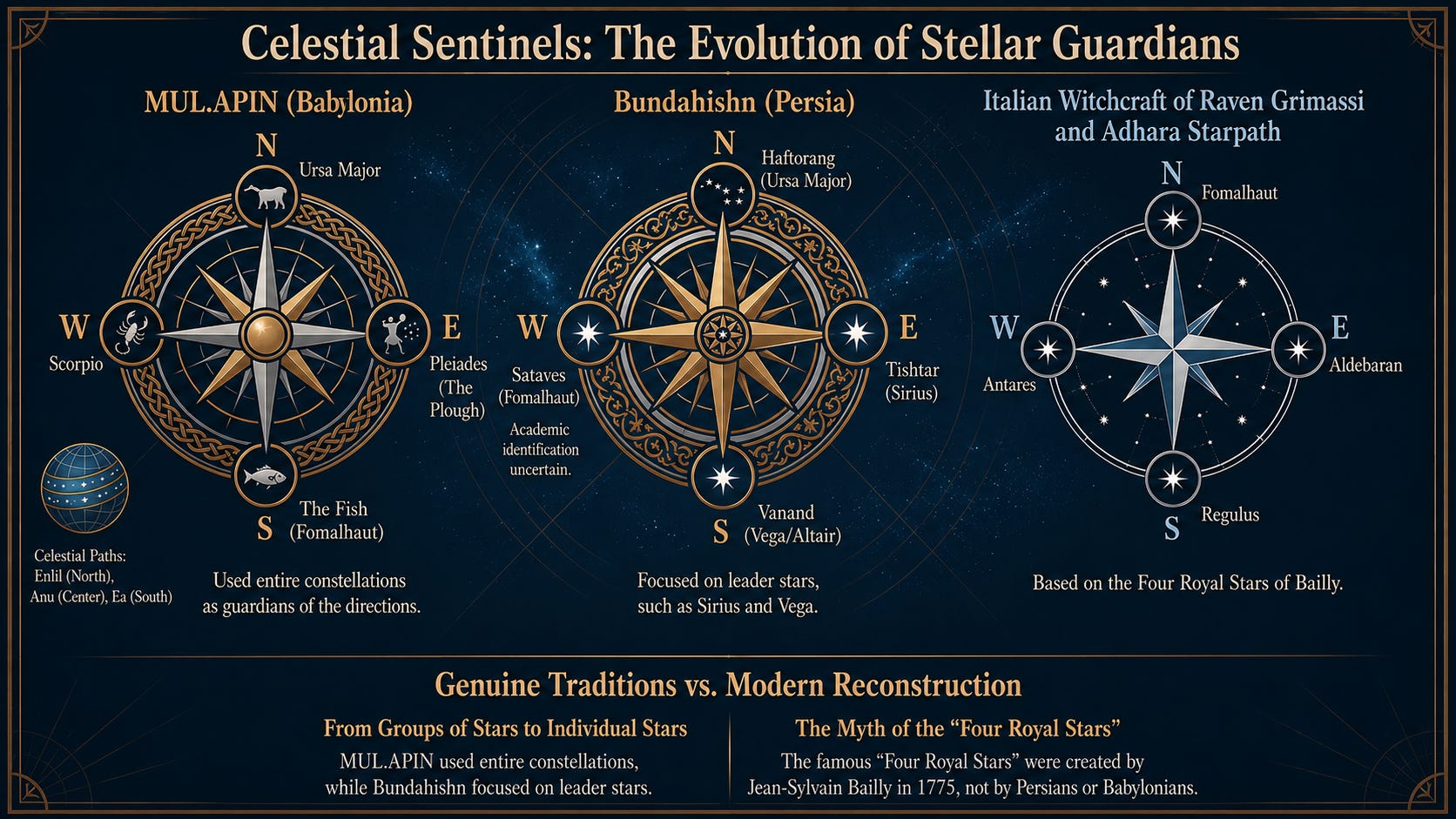
The guardians of the sky across different traditions and eras, with the probable Stars/constellations that occupied the four directions. Made with NotebookLM.
The Real Ziggurats
In my book [1], I had written that the ziggurats of Mesopotamia were towers built bearing the symbols of the Grigori, 82 meters tall. This information was also found in esoteric books, and is, most likely, another effect of the telephone game.
Ziggurats had no relation to the four Guardians of the directions — they never did. More than 30 of them have been found in different Mesopotamian cities, the oldest in Eridu, dating back to the third millennium BCE. Each one was dedicated to a single deity: the Etemenanki, the most famous of them, built in Babylon, was dedicated to Marduk, and its name means something like “the House of the Foundation of Heaven and Earth” — likely the structure that inspired the biblical account of the Tower of Babel [16].
The Etemenanki had seven stories, not four, and each was painted a different color: white, black, red, white again, orange-red, silver, and, at the top, gold [8]. The Greek historian Diodorus Siculus, in the 1st century BCE, went so far as to propose that these seven levels represented the five planets visible to the naked eye plus the Sun and the Moon [16]. At the top stood a temple, and according to Diodorus himself, it was from there that the Chaldean priests made their observations of the sky, taking advantage of the structure’s height: a cult devoted to the fate of the king and the nation, read in the celestial omens [10, 16].
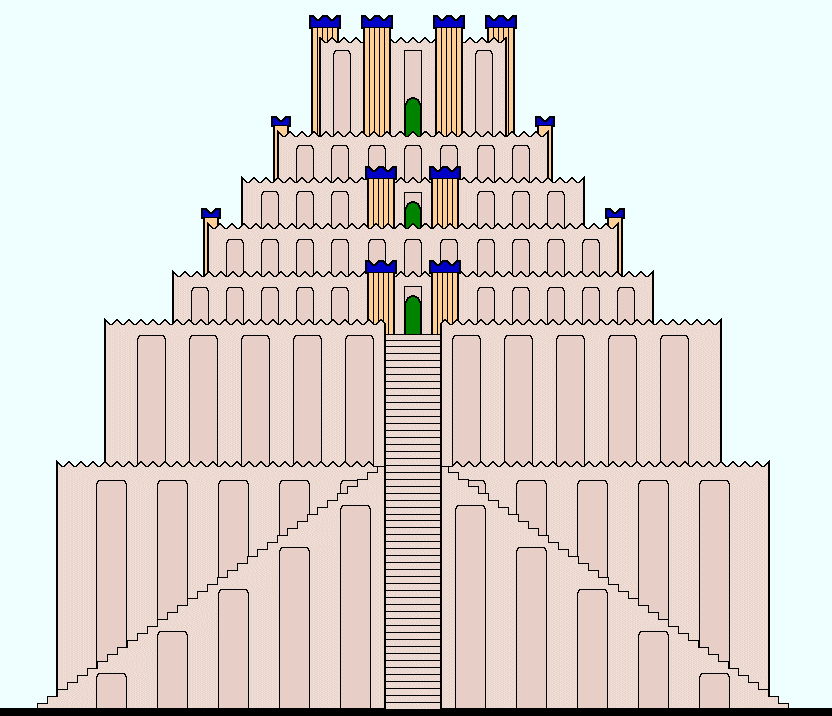
By Jona Lendering at en.wikipedia - from Wikipedia, public domain — https://commons.wikimedia.org/w/index.php?curid=15007476
According to the Mesopotamian tablet describing its layout, the Etemenanki stood around 91 meters (300 feet) tall, and the historian Herodotus, who visited it still standing in the 5th century BCE, describes something on the same scale [16]. Today, however, only its foundations remain: the structure itself was destroyed centuries ago, and no height can be confirmed anymore through excavation. Even so, it was the largest ziggurat ever built; the others, like the one at Ur, were considerably smaller [16]. There is no record of any ziggurat ever built for the Grigori or for any quartet of four guardians: that idea, like the quartet itself, appears later than the Mesopotamian period, and did not originate from it.
The Genealogy of the Royal Stars
The idea of dividing the sky is even older than MUL.APIN [10]. But the most important thing in all this isn’t whether the Grigori are ancient or not. The modern concept of the Royal Stars isn’t a single tradition, passed down intact since antiquity; it’s the result of a fusion of different traditions, born in different times and places, which only met much later.
The timeline below shows how these different traditions arose independently, and were only brought together in building the modern concept of the Royal Stars:
1200 BCE — The “Three Stars Each” Texts in Mesopotamia
The first formal lists appear, organizing the sky into three great Paths: Enlil, Anu, and Ea, each with its own reference stars and astronomical functions [10, 11]. There is still no quartet of four guardian stars.
1000 BCE — MUL.APIN
The three Paths are systematized in the Babylonian compendium MUL.APIN, which brings together star names, constellations, calendars, and observation methods [10, 11]. The organization of the sky was based mainly on the three Paths and on stellar groups, not on four individual stars tied to the cardinal points.
900–400 BCE → 9th century CE — The Persian tradition
In the youngest layer of the Avesta, four great sentinels of the sky appear: Tishtar (East), Sataves (West), Vanand (South), and Haftorang (North) [14]. These texts were preserved orally for centuries, written down during the Sassanid period (4th–6th centuries CE), and have reached us compiled in the Bundahishn, in the 9th century CE [15].
1st–16th centuries — The Hermetic tradition and stellar magic
Alongside the Mesopotamian and Persian traditions, a third strand develops: that of astral magic. Drawing on the Hermetic tradition [19], Hellenistic astrology, and later works such as the Liber Hermetis [20], the Picatrix [21], and Heinrich Cornelius Agrippa’s De Occulta Philosophia [22], the practices of stellar talismans and the magical correspondences of the Behenian stars take shape. In none of these works, however, does the concept of “Four Royal Stars of Persia” appear.
1775 — Jean-Sylvain Bailly
In Histoire de l’astronomie ancienne, Bailly proposes that Fomalhaut, Aldebaran, Regulus, and Antares preserved the memory of an ancient Persian tradition tied to the four cardinal points [3].
19th century — Western esotericism
Bailly’s hypothesis gradually spread through popular astronomical, astrological, and occult literature. Throughout the 19th century, the stellar quartet came to be associated with fourfold symbolic systems — such as the four elements, the four cardinal points, the four archangels, and the guardians of the directions — being progressively absorbed into Western esotericism [7, 23, 24]. It’s in this context that the modern concept of the Four Royal Stars takes final shape.
20th century — Absorption into modern witchcraft
Throughout the 20th century, this now-consolidated quartet was absorbed by various currents of ceremonial magic, Italian Witchcraft, and Wicca, and came to be frequently presented as an ancient Persian tradition. In this context, Aldebaran, Regulus, Antares, and Fomalhaut became known as the Grigori, Watchers, Guardians, or Guardians of the Watchtowers, carrying out functions of ritual protection and guarding the four directions [25-27].
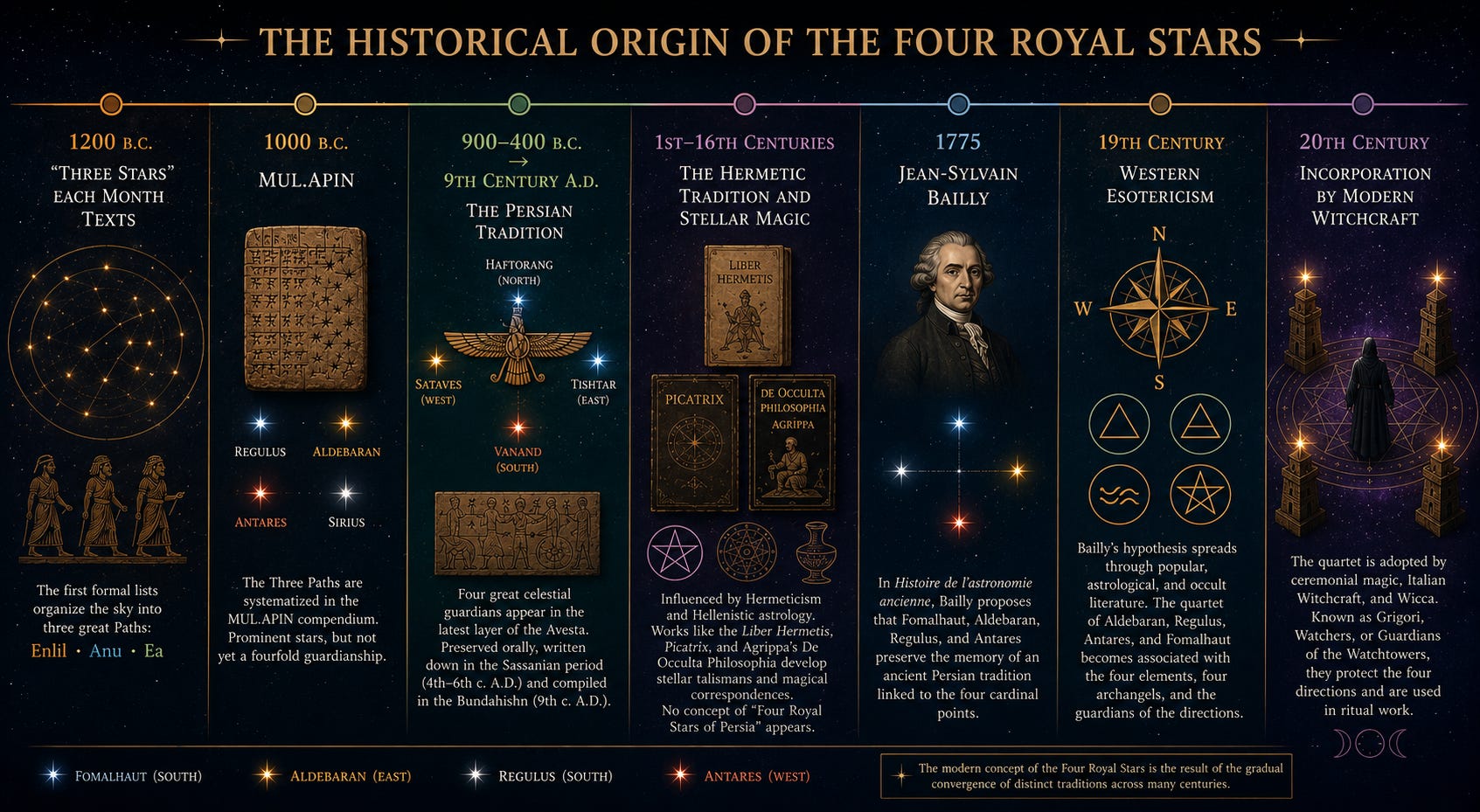
Timeline of the Stars of the Directions, made with ChatGPT.
Sirius: An Unexpected Reunion
There are stars we choose, and there are stars that choose us first, long before we know how to name them. Sirius has always been like that with me: it shone on my path before I understood its full meaning. When I finally went looking through the Mesopotamian sources, what I found warmed my heart. There she was, shining in the ancient texts too: the Path of Anu, the central road of the sky along which the Sun, the Moon, and the wandering gods traveled.
The connection we hold with Sirius today was born from our own lived experience, from our practice. And still, the very same star we feel was already pulsing with importance for the Babylonians five thousand years ago — under a different name, a different face, a different function, but the same light calling out for attention.
I don’t know about you, but I don’t believe in coincidences. I find it beautiful to think that some stars travel through entire civilizations, each time carrying out a function that made sense for its own age. That, to me, is the true gift of this research: noticing the layers of meaning that each people, each generation, has stacked onto the very same sky.
On Adhara Starpath, gnosis and research have never competed. Experience is what makes me feel Sirius pulsing; history is what shows me that this pulse echoes far beyond me. And it’s in this meeting point — between what we live and what we discover — that our practice gains its true weight: when the two things touch, our conversation with the stars grows deeper, more conscious, more present.
Learning all of this led me to an inevitable question:
If the Royal Stars didn’t exactly originate in Persia... where did the other ideas we practice today come from? How did star worship begin? What was preserved and what transformed over time?
References
- Daw, A., A. Athenodoros, and S. Zahara, A Magia das Estrelas: Princípios de Magia Estelar. 2019: Amazon Digital Services LLC - Kdp.
- Butler, R. and T. Johnson, The Behenian Fixed Stars: An Oracle and Guide. Medieval Astrology Guide.
- Bailly, J.-S., Histoire de l’astronomie ancienne, depuis son origine jusqu’à l’établissement de l’École d’Alexandrie. 1775, Paris.
- Davis, G.A., Jr., The so-called royal stars of Persia. Popular Astronomy, 1945. 53: p. 149.
- Arago, F., Astronomie Populaire. 1861, Paris: Gide et J. Baudry.
- Flammarion, C., Histoire du Ciel. 1872, Paris: Librairie Hachette.
- Allen, R.H., Star Names: Their Lore and Meaning. 1963, New York: Dover Publications.
- Grimassi, R., Hereditary Witchcraft: Secrets of the Old Religion. 1999, St. Paul: Llewellyn Publications.
- Grimassi, R., Italian Witchcraft: The Old Religion of Southern Europe. 2000, St. Paul: Llewellyn Publications.
- Rochberg, F., The Heavenly Writing: Divination, Horoscopy, and Astronomy in Mesopotamian Culture. 2004, Cambridge: Cambridge University Press.
- Hunger, H. and D. Pingree, MUL.APIN: An Astronomical Compendium in Cuneiform. 1989, Horn: Verlag Ferdinand Berger & Söhne.
- Hunger, H. and D. Pingree, Astral Sciences in Mesopotamia. 1999, Leiden: Brill.
- Rogers, J.H., Origins of the Ancient Constellations: I. The Mesopotamian Traditions. Journal of the British Astronomical Association, 1998. 108(1): p. 9–28.
- Panaino, A., Tištrya, in Encyclopaedia Iranica. 2005.
- West, E.W., The Bundahishn, in Sacred Books of the East. 1897, Clarendon Press: Oxford.
- Panaino, A., Tištrya, Part I: The Avestan Hymn to Sirius. Serie Orientale Roma LXVIII.1. 1990, Rome: IsMEO.
- Panaino, A., Tištrya, Part II: The Iranian Myth of the Star Sirius. Serie Orientale Roma LXVIII.2. 1995, Rome: IsMEO.
- Panaino, A., Haftōrang, in Encyclopaedia Iranica. 2002. p. 533–534.
- Copenhaver, B.P., Hermetica: The Greek Corpus Hermeticum and the Latin Asclepius. 1992, Cambridge: Cambridge University Press.
- Charles, B. and G. Dorian Gieseler, The Liber Hermetis. 2022, Turnhout: Brepols.
- al-Majriti, P.-M., Picatrix (Ghayat al-Hakim). 2013: Grupo de Traduções Ocultas (G.T.O.).
- Agrippa, H.C., Three Books of Occult Philosophy (De Occulta Philosophia libri III). 1651: Ed. Joseph Peterson (2000).
- Goodrick-Clarke, N., The Western Esoteric Traditions: A Historical Introduction. 2008, Oxford: Oxford University Press.
- Hanegraaff, W.J., Western Esotericism: A Guide for the Perplexed. 2013, London: Bloomsbury Academic.
- Doyle White, E., Wicca: History, Beliefs, and Community in Modern Pagan Witchcraft. 2016, Brighton: Sussex Academic Press.
- Hutton, R., The Triumph of the Moon: A History of Modern Pagan Witchcraft. 1999, Oxford: Oxford University Press.
- Magliocco, S., Witching Culture: Folklore and Neo-Paganism in America. 2004, Philadelphia: University of Pennsylvania Press.